Soursop at a Glance
Everything worth knowing about Annona muricata on one page: the profile, the numbers, the chemistry, the flavor and the caveats. Every figure here is sourced, and where the popular version of a fact is wrong, we say so.
- Kingdom
- Plantae
- Family
- Annonaceae
- Genus
- Annona
- Species
- A. muricata
- Native to
- Tropical Americas
- Tree height
- 4–10 m
- Fruit weight
- 1–4 kg
- Ripe shelf life
- 2–3 days
Also called guanábana, graviola, guyabano, corossol, sirsak and durian belanda. The English name comes from the Dutch zuurzak, “sour sack.” Full list of names →
Soursop on a single page
The whole entry as a printable reference chart. Everything on it is expanded, with sources, further down this page.
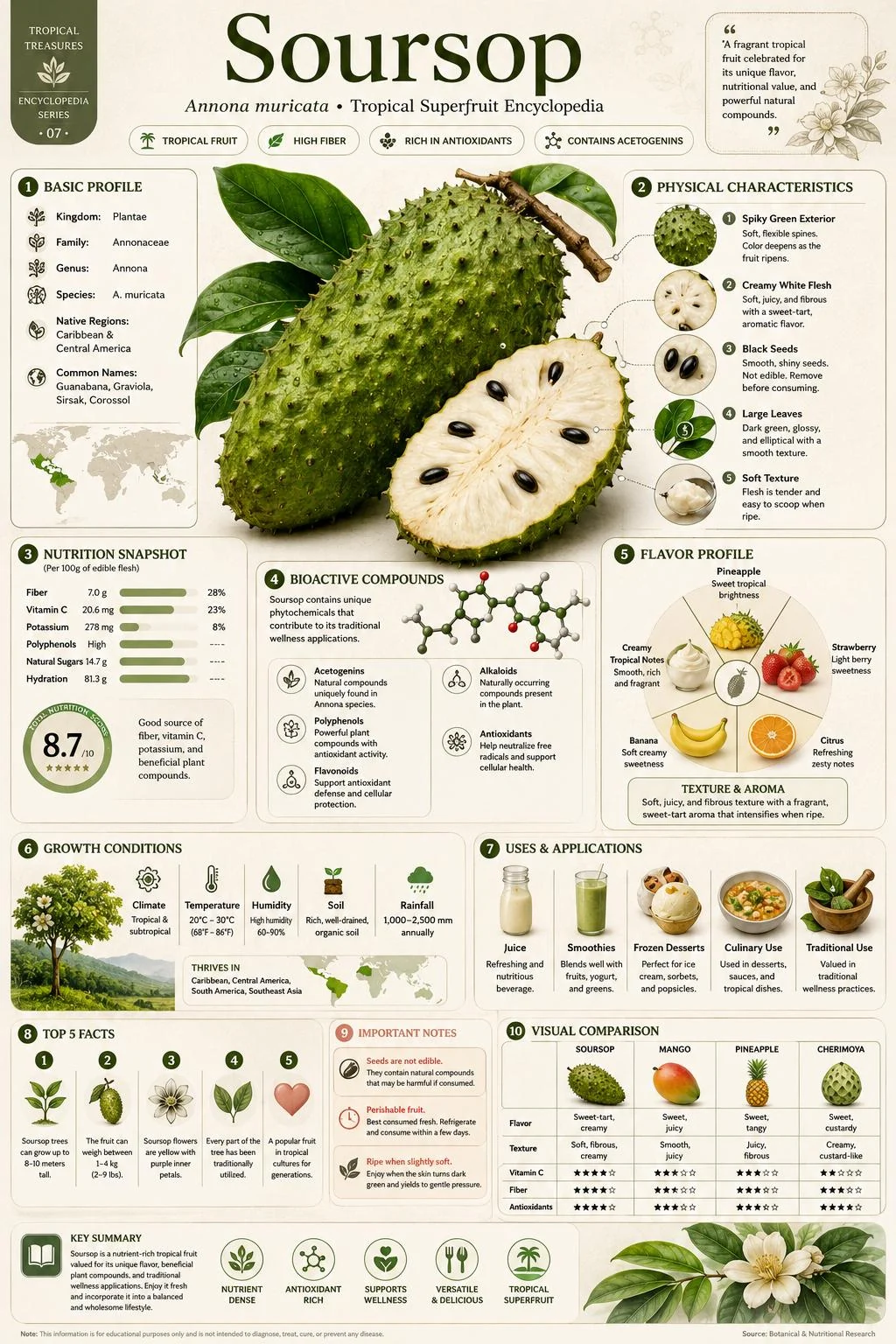
Two figures on the chart to read with care
The chart lists fiber at 7.0 g per 100 g. That is the per-cup figure — USDA gives 3.3 g per 100 g, and 7.4 g for a full 225 g cup. It also rounds potassium to 8% of the Daily Value where the calculation gives about 6%. The nutrition panel and the snapshot below carry the verified numbers.
Physical characteristics
Spined green skin
A thin, dark-green rind covered in soft, fleshy, recurved spines that bend under a fingertip. They are fused carpel tips, not thorns. Color dulls toward yellow-green as the fruit ripens.
Creamy white flesh
Moist, fibrous and divided into soft lobes. White — never yellow or orange. This is the entire edible part.
Glossy black seeds
Thirty to two hundred per fruit, one to a lobe, about 1.5 cm long. Not edible. They concentrate annonacin and are always discarded.
Fibrous core
A narrow pale column running from the stem through the center. Edible but tough; most people cut it out.
Leaves
Oblong-elliptic, 8–16 cm, leathery, dark and glossy above, arranged alternately along the branch. Dried for tea.
Texture
Closer to a soft custard than a juicy fruit — the usual surprise for first-timers. Scoopable with a spoon when ripe.
What is actually in 100 g
Raw pulp. Source: USDA FoodData Central. Bars show percentage of the US Daily Value for an adult.
Alongside that: 66 calories, 81.2 g water, 16.8 g carbohydrate and 13.5 g naturally occurring sugar, with effectively no fat. A full cup (225 g) multiplies all of it by 2.25 — which is where the often-quoted “7.4 g of fiber” figure comes from. That number is per cup, not per 100 g, and it is very commonly misprinted as the latter.
How it compares to eight fruits you already know
Per 100 g of raw fruit, every figure from USDA FoodData Central. The last column is fiber divided by sugar — a rough read on how much brake each fruit brings along with its sweetness.
| Per 100 g, raw | Calories | Fiber | Vitamin C | Sugars | Fiber per g sugar |
|---|---|---|---|---|---|
| Soursop | 66 | 3.3 g | 20.6 mg | 13.5 g | 0.24 |
| Guava | 68 | 5.4 g | 228.0 mg | 8.9 g | 0.61 |
| Cherimoya | 75 | 3.0 g | 12.6 mg | 12.9 g | 0.23 |
| Banana | 89 | 2.6 g | 8.7 mg | 12.2 g | 0.21 |
| Orange | 47 | 2.4 g | 53.2 mg | 9.4 g | 0.26 |
| Blueberries | 57 | 2.4 g | 9.7 mg | 10.0 g | 0.24 |
| Papaya | 43 | 1.7 g | 60.9 mg | 7.8 g | 0.22 |
| Mango | 60 | 1.6 g | 36.4 mg | 13.7 g | 0.12 |
| Pineapple | 50 | 1.4 g | 47.8 mg | 9.9 g | 0.14 |
The honest reading
Fiber is where soursop genuinely stands out. Of these nine fruits only guava carries more, and soursop brings roughly twice the fiber of a mango, a pineapple or a papaya. That matters more than it sounds, because soursop is also one of the sweeter fruits here.
Vitamin C is not. Guava, papaya, orange, pineapple and mango all beat it. A fruit can be worth eating without topping every column, and pretending otherwise is how the “superfruit” label got worn out.
The other genuine distinction does not appear in this table at all: acetogenins, a compound class found almost nowhere outside the Annona family. None of the other eight fruits contain them. What they are →
Why the glycemic question is really a question about form
Soursop is a sweet fruit — 13.5 g of natural sugar per 100 g, near the top of the table above. What it also carries is fiber, and at a better ratio than most: roughly twice the fiber per gram of sugar that a mango or a pineapple brings.
That ratio is the part worth understanding. Dietary fiber slows gastric emptying and the rate at which sugars are absorbed — settled nutrition, not a soursop-specific finding. The practical consequence is that the same sugar behaves differently depending on what it arrives with.
- Whole fruit and frozen pulp. All of the fiber, all of the sugar. The fruit as it actually is.
- Juice with the pulp retained. Keeps a meaningful share of the fiber, so the sugars still arrive with something alongside them.
- Clarified or filtered juice, and nectar. The fiber is strained out and, with nectar, more sugar is often added. This is sugar with the brake removed.
What we will not print
A glycemic index number for soursop. We have not found one from a source we would stand behind, so we are not going to invent confidence we do not have. If a seller quotes you a precise GI for this fruit, ask where it came from — and note that any such figure would apply to one specific product, not to soursop in general.
SOPREME — the pulp kept in, and the testing published
Most soursop juice reaches the shelf with no published testing at all, which is why a “100% juice” label on its own tells you very little. SOPREME is the exception we point people to.
- 100% soursop juice, with the pulp retained
- Never from concentrate, and no added sugar
- Independent batch testing for identity and purity
- BRIX verified against the natural range for real soursop
- Glycemic tested on the finished juice
- Pressed from whole ripe fruit, never diluted
BRIX verification is the substantive one. It is a measurable check that the juice sits in the natural sugar range of genuinely pressed soursop — which is how dilution and reconstituted concentrate get caught, the two things that make a “100% juice” claim meaningless.
Bioactive compounds
Acetogenins
Found almost only in this plant family. Over 100 isolated from A. muricata. They inhibit mitochondrial complex I — the source of both the research interest and the safety caveat.
Alkaloids
Isoquinoline alkaloids such as reticuline, concentrated in leaf and bark.
Polyphenols
Quercetin, luteolin and related flavonoids, plus tannins and phytosterols.
Vitamin C & fiber
The part that actually reaches you from eating the fruit, as opposed to from an extract.
What it tastes like
No single fruit describes it. These are the notes people reach for most consistently.
Growth conditions
- Climate
- Humid lowland tropics
- Temperature
- 25–28 °C
- Humidity
- High, 60–90%
- Rainfall
- 1,000–2,500 mm/yr
- Elevation
- 0–1,000 m
- Hardiness
- USDA zone 10+
- Seed to fruit
- 3–5 years
- Pollination
- Beetles, often by hand
Five things most articles leave out
- It is not related to durian. The resemblance is superficial and the confusion is constant. Soursop spines are soft and bend; durian spines are hard and sharp, and the two are in entirely different plant families.
- The flowers grow out of the trunk. Cauliflory — blooms emerge from old wood, not just new twigs. Sap beetles pollinate them so unreliably that commercial growers do it by hand with a brush.
- It is the largest fruit in its genus. Typically 1–4 kg, with records around 7 kg — far bigger than its relatives the cherimoya and sugar-apple.
- Ripe, it lasts about two days. That single fact explains why almost everyone outside the tropics meets soursop as juice, frozen pulp or tea rather than as fruit.
- The leaf and the fruit are different products. Most of the dramatic laboratory findings attached to “soursop” were run on concentrated leaf extract, not on the fruit and not at tea strength.
Three things to be clear about
Never eat the seeds
They hold the fruit’s highest concentration of annonacin. Not a supplement, not a smoothie ingredient. Scoop, spit, discard.
It does not treat cancer
No clinical trial shows any such effect in people. The claim comes from cell-culture work, and the FDA lists graviola among products marketed with unproven cancer claims. The full account →
Go easy on extracts
Fruit in normal amounts has a long record as food. Concentrated leaf and seed extracts taken daily are where the genuine safety questions sit. Safety notes →
This page is general information about a food, not medical advice, and nothing here has been evaluated by the US Food and Drug Administration. Soursop is not intended to diagnose, treat, cure or prevent any disease.